
Best Crypto Wallets in 2026: Hot vs Cold Storage Compared
Choosing a crypto wallet is one of those decisions that seems simple until you actually have funds at stake. The right choice depends entirely on how you use crypto — trading daily, holding long-term, or actively using DeFi — and getting the mismatch wrong is how most self-custody losses happen. Here’s a full breakdown of hot vs. cold wallets, what’s changed in wallet security in 2026, and how to actually choose between them.
Hot Wallets vs. Cold Wallets: The Core Difference
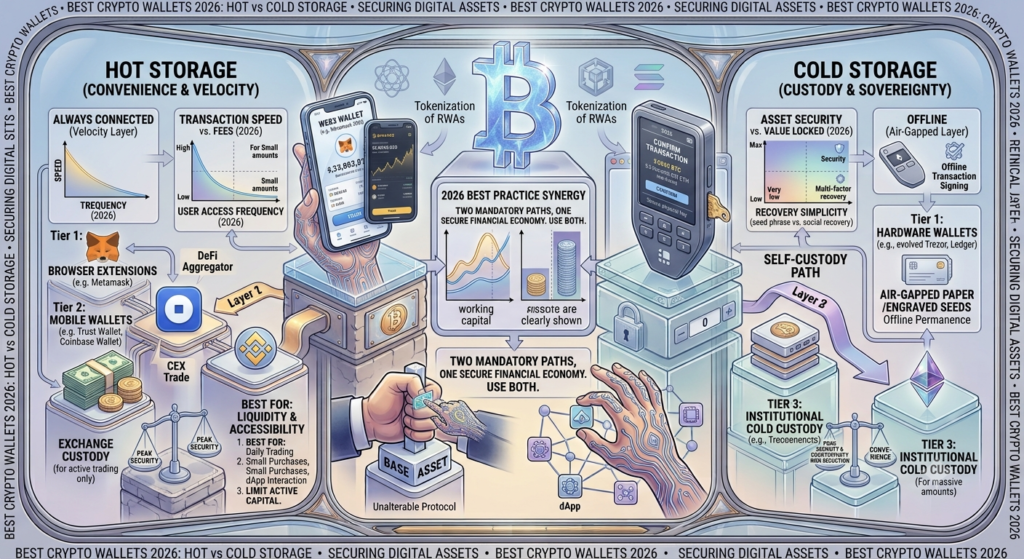
A **hot wallet** is any wallet connected to the internet — a mobile app, browser extension, or desktop program. Hot wallets are fast and convenient, making them the right tool for frequent transactions, DeFi interactions, and day-to-day spending. The trade-off is exposure: because they’re connected to a network-facing device, they inherit that device’s attack surface, including phishing, malware, and compromised browser extensions.
A **cold wallet** (almost always a hardware device) keeps private keys generated and stored entirely offline. You only connect it briefly to sign a specific transaction, and the keys themselves never touch an internet-connected system. This eliminates most remote attack vectors — a hacked laptop can’t extract keys it never had access to — at the cost of convenience. Cold wallets are the standard recommendation for any funds you’re not actively using.
Most experienced holders use both: a hot wallet for spending money and small, active positions, and a cold wallet for the bulk of long-term holdings. This mirrors how people generally treat a checking account versus a savings account — one for regular use, one for funds you don’t need to touch often.
What’s Changed in Hardware Wallet Security
The hardware wallet market has moved noticeably since the early days of simple USB devices. A few developments define the current generation:
**EAL6+ secure element chips are now standard, not premium.** These are the same class of chips used in passports and credit cards, certified under the Common Criteria framework to resist sophisticated physical attacks like side-channel analysis. A few years ago, this level of certification was reserved for high-end devices; it’s now common in mid-range hardware wallets.
**Air-gapped signing is increasingly preferred over USB-only connections.** Devices that communicate exclusively via QR code scans or NFC taps — rather than a USB or Bluetooth connection — remove an entire category of attack vector, since there’s no direct data pipeline between the wallet and a potentially compromised computer.
**Seedless architectures are gaining ground.** Traditional hardware wallets rely on a 12- or 24-word seed phrase as the master recovery key — a system that’s powerful but also the single point of failure behind most real-world hardware wallet losses (photographed phrases, phishing sites requesting them, physical theft of a written copy). Newer designs from some manufacturers replace the seed phrase with a set of physical backup cards using NFC, each capable of independently accessing the wallet, removing the need to manage a written phrase at all.
**Post-quantum cryptography research has begun appearing in flagship devices.** No currently operating quantum computer can break the cryptography protecting Bitcoin or Ethereum today, but some manufacturers have started shipping devices with quantum-resistant signing architectures aimed at holders with multi-decade time horizons, following NIST’s finalized post-quantum cryptography standards.
How to Choose: Match the Wallet to Your Use Case
**If you’re a long-term holder (“HODLer”)** who transacts rarely, a hardware wallet is the clear choice. You’re optimizing for maximum security and can tolerate the extra friction of connecting a device for infrequent transactions.
**If you’re an active DeFi user** who interacts with smart contracts, swaps, or yield protocols regularly, a hybrid setup makes the most sense: a software hot wallet (like a browser extension) for daily interaction, paired with a hardware wallet holding the bulk of your funds that you only connect when moving larger amounts.
**If you’re a complete beginner** intimidated by hardware wallet setup, some newer devices are specifically designed around simplicity — tap-to-connect via smartphone, no cables, no desktop software required — trading a small amount of advanced flexibility for a much shorter learning curve.
**If your priority is Bitcoin specifically** rather than a broad multi-chain portfolio, Bitcoin-only hardware wallets exist that strip out multi-chain complexity in favor of deeper support for Bitcoin-specific features like multisignature setups and Partially Signed Bitcoin Transactions (PSBT), which are relevant for more advanced self-custody arrangements involving multiple keys.
Comparing Wallet Types
| Wallet Type | Best For | Key Strength | Key Trade-off |
| Hardware (cold) wallet | Long-term storage | Keys never touch the internet | Less convenient for frequent use |
| Browser extension (hot) wallet | DeFi, NFTs, dApp interaction | Fast, direct app connectivity | Exposed to browser/device compromise |
| Mobile app (hot) wallet | Everyday spending, smaller balances | Convenient, always on hand | Vulnerable if phone is compromised |
| Custodial exchange wallet | Active trading | No setup required, easy to use | You don’t control the private keys |
| Multi-party computation (MPC) wallet | Users wanting no single seed phrase | Splits key control across parties | Newer technology, less battle-tested |
Security Practices That Matter More Than Brand Choice
No wallet — hot or cold — protects you from mistakes in how you use it. A few practices matter more than which specific device or app you pick:
– **Buy hardware wallets directly from the manufacturer**, never from third-party marketplaces. There have been documented cases of devices being tampered with and resold with a pre-known seed phrase, allowing thieves to drain funds the moment a victim transfers money in.
– **Never enter your seed phrase into a website, app, or message**, no matter how convincing the request looks. Legitimate wallet providers never ask for it, and any prompt requesting it should be treated as an attempted theft.
– **Watch for “blind signing.”** Many DeFi and NFT transactions involve approving complex smart contract interactions that aren’t fully human-readable on a wallet’s confirmation screen. Where possible, use wallets and interfaces that clearly display what you’re approving, and be cautious approving anything you don’t understand.
– **Keep your backup phrase (or backup cards) physically secure and offline** — ideally in more than one location, and never photographed or stored in a cloud service.
– **Use a passphrase (25th word) if your hardware wallet supports it.** This adds a layer of protection even if your physical device or written seed phrase is ever discovered, since the passphrase itself is never written down.
A Note on Custodial vs. Non-Custodial
It’s worth being explicit about a distinction that trips up a lot of newcomers: keeping funds on a centralized exchange is not the same as using a wallet, even though the exchange interface looks and feels like one. When you hold crypto on an exchange, the exchange controls the private keys — you have a claim on the asset, not direct ownership of it on-chain. This isn’t inherently unsafe for actively traded funds on a well-regulated platform, but it does mean your holdings are exposed to that platform’s solvency and security, not just your own. “Not your keys, not your coins” has become something of an industry maxim for a reason — it’s a useful reminder to move meaningful long-term holdings into a wallet where you actually control the keys.
The Bottom Line
There’s no single “best” crypto wallet in 2026 — there’s a best wallet for your specific pattern of use. Hardware wallets remain the gold standard for anything you plan to hold rather than actively trade, and the current generation has meaningfully raised the bar on both security certifications and ease of use. Software wallets remain essential for anyone actively engaging with DeFi or NFTs, provided they’re paired with good security hygiene and not used to store the bulk of your holdings. The safest approach for most people combines both: a hot wallet for what you’re using, and cold storage for what you’re keeping.
*This article is for informational purposes only and does not constitute financial or security advice specific to your situation. Always research any hardware or software wallet independently before entrusting it with funds.*