
Stablecoins Explained: USDT vs USDC in 2026 (And What’s Changing)
Stablecoins are the plumbing of the crypto economy — the asset most traders use to move between positions, the collateral behind much of DeFi, and increasingly, a genuine payment tool used well beyond crypto-native circles. Yet most people who use them daily couldn’t clearly explain how they actually work, or why 2026 has been such a pivotal year for how they’re regulated. Here’s a full breakdown.
What a Stablecoin Actually Is
A stablecoin is a cryptocurrency designed to maintain a stable value, almost always pegged to a fiat currency like the U.S. dollar, at a 1:1 ratio. Unlike Bitcoin or Ethereum, whose prices fluctuate with market supply and demand, a well-functioning stablecoin is engineered so that one token is always redeemable for (or closely tracks the value of) one dollar.
They solve a real problem: crypto markets trade 24/7 with no traditional banking rails in the loop, and traders need a way to exit a volatile position, hold value between trades, or move funds across exchanges without constantly converting back to a bank account. Stablecoins fill that role, functioning as the dollar-equivalent “cash” layer of the crypto ecosystem.
The Three Main Types of Stablecoins
**Fiat-collateralized stablecoins** are backed by reserves of actual dollars (or dollar-equivalent assets like short-term Treasury bills) held by the issuing company. USDT (Tether) and USDC (Circle) are the two largest examples, and both claim to maintain reserves equal to or exceeding the tokens in circulation, backed by periodic attestations from accounting firms.
**Crypto-collateralized stablecoins** are backed by other cryptocurrencies rather than fiat currency, typically over-collateralized to absorb price volatility in the underlying collateral. DAI, issued by the MakerDAO protocol (now largely rebranded as Sky), is the best-known example — a token that maintains its dollar peg through a system of crypto-backed loans rather than a bank account full of dollars.
**Algorithmic stablecoins** attempt to maintain their peg through code-based supply adjustments rather than holding collateral at all. This category suffered a defining reputational blow when TerraUSD collapsed in 2022, wiping out tens of billions of dollars in value within days and demonstrating how fragile purely algorithmic designs can be under stress. Few algorithmic stablecoins have regained meaningful market share since.
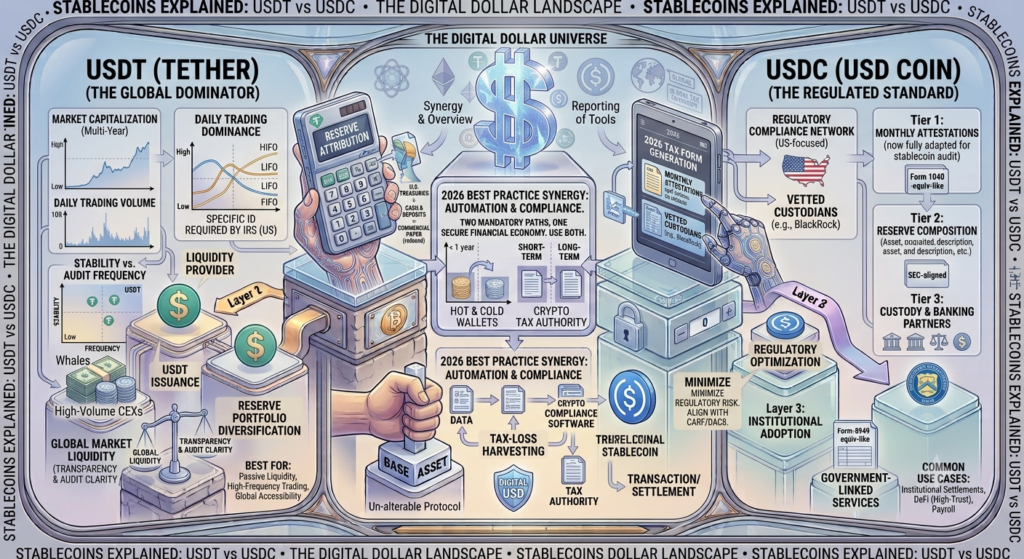
USDT vs. USDC: The Two Giants
**USDT (Tether)** remains the largest stablecoin by market capitalization and by trading volume, and it’s the dominant stablecoin used on centralized exchanges globally, particularly outside the U.S. Tether has faced recurring scrutiny over the years about the composition and transparency of its reserves, though it has moved toward more frequent attestations over time. Its scale and liquidity across nearly every trading pair on nearly every exchange remain its biggest competitive advantages.
**USDC (Circle)** has generally positioned itself as the more transparency-focused, U.S.-regulation-friendly alternative, with reserves held primarily in cash and short-term U.S. Treasuries and more frequent public reporting. USDC has become the dominant stablecoin within U.S.-based DeFi protocols and among institutions that prioritize regulatory clarity, and Circle’s own path toward becoming a publicly traded, more heavily regulated company has reinforced that positioning.
In practice, the choice between the two often comes down to where you’re transacting: USDT tends to have deeper liquidity on international and offshore exchanges, while USDC tends to be preferred within U.S.-regulated platforms and DeFi protocols that emphasize compliance.
The Stablecoin Market Has Actually Shrunk in 2026
Despite stablecoins’ central role in crypto infrastructure, their combined market capitalization has declined meaningfully this year rather than grown. The combined value of USDT and USDC fell from roughly $268 billion to around $257 billion over a recent two-month stretch, and broader stablecoin market cap figures showed an even larger monthly decline earlier in the year — the largest single-month drop since the TerraUSD collapse, though for very different reasons this time.
This decline reflects net capital leaving the crypto ecosystem altogether rather than simply rotating between assets: investors have been converting crypto positions into stablecoins and then withdrawing that value out of the on-chain system entirely, rather than redeploying it back into Bitcoin, Ethereum, or altcoins. It’s a useful reminder that stablecoin supply is itself a rough proxy for how much capital is actively sitting inside the crypto economy at any given moment.
The GENIUS Act: Stablecoins Now Have a Federal Framework
A major shift for the U.S. stablecoin market took effect with the GENIUS Act, signed into law in mid-2025, which established the first comprehensive federal framework specifically for payment stablecoins. Its core provisions require stablecoin issuers to maintain reserves in cash or short-term Treasuries, provide regular public disclosures, and generally prohibits issuers themselves from paying interest directly to token holders simply for holding the stablecoin.
That last provision has become one of the more contentious sticking points in broader crypto legislation moving through Congress, since it’s raised the question of whether crypto exchanges and platforms — as opposed to the issuers themselves — should be allowed to offer interest-like rewards to users who hold stablecoins on their platform. The GENIUS Act’s own implementing rulemaking deadline falls in mid-2026, meaning the practical details of enforcement are still being finalized even as the broader legislative framework is in effect.
Global Regulation Is Moving Even Faster
Outside the U.S., stablecoin regulation has in some respects moved further and faster. The EU’s Markets in Crypto-Assets regulation (MiCA) reached full enforcement in July 2026, consolidating stablecoin and broader crypto licensing across all 27 member states and ending the prior patchwork of national registrations. Notably, some major stablecoin issuers have already secured full MiCA authorization, positioning them to operate across the entire EU under one unified rulebook rather than negotiating separate approvals country by country.
Hong Kong and Singapore have also moved quickly on their own stablecoin licensing regimes, and some U.S. policymakers have publicly acknowledged that regulatory lag domestically risks pushing stablecoin issuers and broader crypto infrastructure toward jurisdictions with clearer rules already in place.
What Stablecoins Are Actually Used For
While trading remains the largest single use case, stablecoin usage for genuine payments has grown substantially. Wallet providers have reported crossing meaningful milestones in daily active payment users — in some cases, payment-focused users now outnumber pure traders on certain platforms for the first time. Growth has been especially pronounced in emerging markets across Southeast Asia, South Asia, Africa, and Latin America, where stablecoins offer a practical alternative for cross-border remittances and a hedge against local currency volatility, sometimes functioning as a more accessible dollar-equivalent savings vehicle than traditional banking access would otherwise allow.
Tokenized real-world assets — bonds, money market funds, and similar instruments issued on-chain — have also increasingly relied on stablecoins as the settlement layer, with trading volumes in this category growing sharply even during periods when broader crypto markets have struggled.
Risks Worth Understanding
Even fiat-collateralized stablecoins, the most conservative category, carry real risks:
– **De-pegging events.** Under extreme market stress, a stablecoin can temporarily trade below its dollar peg if redemption demand outpaces the issuer’s ability to process withdrawals smoothly, even if the underlying reserves are fully intact.
– **Reserve composition and transparency.** Not every issuer provides the same level of detail about what actually backs their tokens, and the difference between a full audit and a lighter “attestation” matters for how much confidence you can place in the reported figures.
– **Counterparty and issuer risk.** A stablecoin is only as reliable as the company issuing it. Regulatory action against an issuer, given how central some issuers are to global crypto liquidity, is one of the more meaningful systemic risks to keep in mind.
– **Smart contract risk for crypto-collateralized designs.** Stablecoins like DAI depend on properly functioning smart contracts and adequate collateralization ratios; a sharp, rapid decline in the value of the underlying collateral can strain the system’s ability to maintain its peg.
The Bottom Line
Stablecoins have quietly become one of the most consequential parts of the crypto ecosystem — not because they’re exciting, but because they’re the connective tissue that lets the rest of the market function. USDT and USDC dominate the space for different reasons: USDT for sheer liquidity and global reach, USDC for regulatory alignment and transparency. With the GENIUS Act now in force in the U.S. and MiCA fully enforced across the EU, 2026 marks the point where stablecoins have moved from a lightly regulated convenience into a formally supervised part of the financial system — even as the market itself has actually contracted this year, a reminder that regulatory maturity and market growth don’t always move in the same direction.
*This article is for informational purposes only and does not constitute financial advice. Always research the reserve backing, regulatory status, and track record of any stablecoin before relying on it.*