
How to Buy Bitcoin Safely: A Step-by-Step Guide for Beginners (2026)
Buying your first Bitcoin can feel more intimidating than it needs to be. Between exchange choices, wallet types, security settings, and tax implications, it’s easy to get overwhelmed before you’ve even placed an order. This guide walks through the entire process step by step, with a focus on the safety practices that actually matter — not just the fastest way to click “buy.”
Step 1: Choose a Reputable, Regulated Exchange
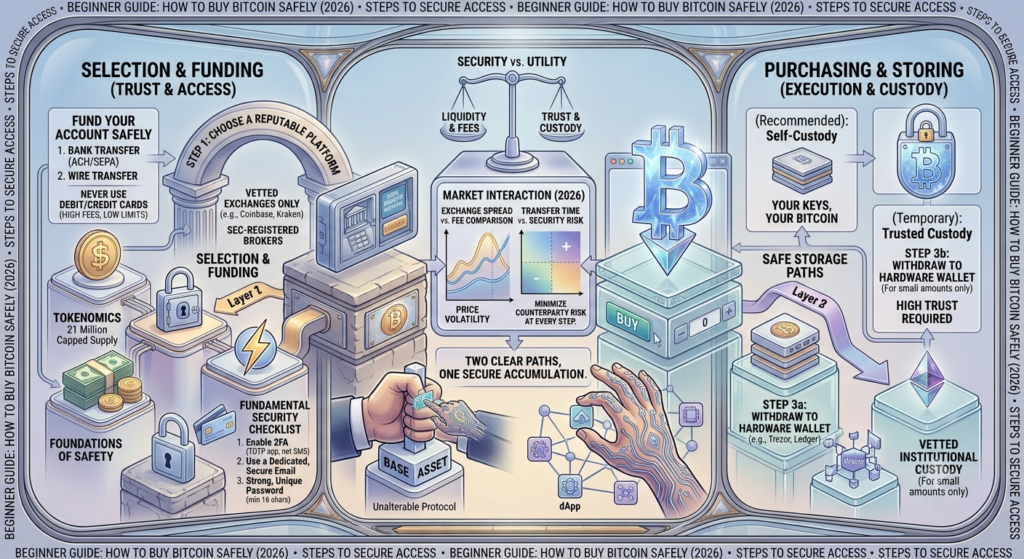
The single biggest safety decision you’ll make is which platform you buy through. In 2026, the exchange landscape has matured considerably compared to a few years ago, but not every platform offers the same level of regulatory oversight, fund protection, or transparency.
When evaluating an exchange, look for:
– **Regulatory registration in your country.** In the U.S., that generally means registration as a money services business with FinCEN and, depending on the state, additional money transmitter licenses. In the EU, look for a MiCA (Markets in Crypto-Assets) license, which became the unified standard across all 27 member states as of mid-2026. In the UK, look for FCA authorization.
– **Proof of reserves.** Some exchanges publish independently verifiable data showing that customer deposits are fully backed by actual holdings. This became a much bigger differentiator industry-wide following past exchange collapses, and its absence on a platform is worth noting.
– **Track record.** How long has the platform operated, and has it ever suffered a security breach that put customer funds at risk? A long, clean operating history isn’t a guarantee of future safety, but it’s a meaningful signal.
– **Fee transparency.** Some platforms charge a visible trading fee; others build their markup into the spread (the difference between the quoted price and what you actually pay). Compare the *total* cost of a trade, not just the advertised fee percentage.
Widely used platforms in 2026 include Coinbase and Gemini (both known for regulatory compliance and beginner-friendly interfaces, at somewhat higher fees), Kraken (strong security track record with generally competitive fees), and Binance and its regional entities (large coin selection and typically the lowest fees, though the interface has a steeper learning curve). Your specific country of residence will narrow this list, since not every exchange operates everywhere.
Step 2: Complete Identity Verification (KYC)
Any legitimate, regulated exchange will require identity verification before you can deposit fiat currency or withdraw significant amounts. This is not optional and it’s not a red flag — it’s a standard anti-money-laundering requirement. Be cautious of any platform that lets you move large amounts of money with zero verification; that’s far more often a sign of a problem than a convenience.
Step 3: Fund Your Account
Common funding methods include bank transfers (ACH in the U.S., SEPA in the EU), debit cards, and increasingly, services like Apple Pay or PayPal on select platforms. Bank transfers are typically the cheapest option but can take a day or more to clear; card payments are instant but usually carry a higher fee, often in the 2–4% range depending on the platform.
A practical tip: avoid depositing more than you’re prepared to see fluctuate significantly in value within days. Bitcoin’s price swings of 5–10% in a single day are not unusual, and funding decisions should reflect that reality.
Step 4: Place Your Order
Most beginner-friendly exchanges offer a simple “buy” interface where you enter a dollar (or other fiat currency) amount and receive the equivalent value in Bitcoin at the current market price, sometimes with a small spread built in. More advanced “pro” trading interfaces on the same platforms often carry lower fees but require you to place limit or market orders directly against an order book — worth learning once you’re past your first few purchases, since the fee savings compound over time.
One widely recommended strategy for beginners is dollar-cost averaging: buying a fixed amount on a regular schedule (weekly or monthly) rather than trying to time a single large purchase. This doesn’t guarantee better returns, but it does reduce the risk of putting a large sum in right before a sharp downturn, and most major exchanges support automated recurring buys.
Step 5: Decide Where to Store Your Bitcoin
This is the step beginners most often skip, and it’s arguably the most important one for actual security.
**Leaving Bitcoin on the exchange** is the easiest option and is reasonable for small amounts you plan to trade actively. But it means you don’t control the private keys — the exchange does. If the platform is hacked, freezes withdrawals, or becomes insolvent, your funds are at risk regardless of how careful you were in choosing it.
**Moving Bitcoin to a self-custody wallet** gives you direct control over your private keys. For amounts you intend to hold long-term, most security-focused guides recommend transferring funds off the exchange and into either a hardware wallet (a physical device that keeps your keys offline) or a well-reviewed software wallet, depending on the amount involved and how often you need access. A commonly cited rule of thumb: if you wouldn’t be comfortable losing it, don’t leave it sitting on an exchange indefinitely.
Essential Security Practices
Regardless of where you buy or store your Bitcoin, a few practices dramatically reduce your risk:
– **Enable two-factor authentication (2FA)** on your exchange account, ideally using an authenticator app rather than SMS, since SMS-based 2FA is vulnerable to SIM-swapping attacks.
– **Use a unique, strong password** for your exchange account, and never reuse a password from another site.
– **Never share your seed phrase or private keys with anyone**, including someone claiming to be customer support. No legitimate exchange or wallet provider will ever ask for this information.
– **Bookmark exchange URLs directly** rather than clicking links from emails or search ads, which are common vectors for phishing sites designed to look identical to the real platform.
– **Be skeptical of unsolicited investment advice**, especially anything promising guaranteed returns or urging you to move funds quickly. This is one of the most common patterns in crypto-related fraud.
– **Start small.** Your first purchase doesn’t need to be large. Get comfortable with the mechanics — buying, withdrawing, and (if applicable) transferring to a personal wallet — before committing significant amounts.
Common Mistakes to Avoid
– **Buying based on hype or social media pressure.** Prices that move sharply based on a single influencer post or trending narrative can reverse just as quickly.
– **Forgetting about fees.** A platform with a “low headline fee” but a wide spread can end up costing more than one with a transparent, higher-looking fee and a tight spread. Always calculate the total cost of a trade before assuming you found the cheapest option.
– **Ignoring tax obligations.** In the U.S. and many other jurisdictions, buying Bitcoin isn’t a taxable event, but selling, trading, or spending it generally is. Keep records from day one rather than trying to reconstruct your transaction history later.
– **Storing your seed phrase digitally.** Taking a photo of your recovery phrase or saving it in a cloud note is one of the most common ways self-custody wallets get compromised. Write it down physically and store it somewhere secure.
– **Skipping research on withdrawal limits and processing times.** Some exchanges impose daily or monthly withdrawal caps, particularly for new accounts, which can be frustrating if you need access to funds quickly.
A Simple Checklist Before You Buy
1. Confirm the exchange is licensed and regulated in your country.
2. Set up 2FA using an authenticator app before funding your account.
3. Start with a small first purchase to learn the platform.
4. Decide your storage plan in advance — exchange, hardware wallet, or software wallet.
5. Keep a personal record of every purchase (date, amount, price) for tax purposes.
6. Never share your seed phrase, and never rush a transaction because someone else is pressuring you to.
The Bottom Line
Buying Bitcoin safely isn’t complicated, but it does require a handful of deliberate decisions: picking a properly regulated exchange, securing your account with real two-factor authentication, and having a clear plan for where your Bitcoin lives once you own it. Most of the risk in this space doesn’t come from Bitcoin itself — it comes from cutting corners on the steps above.
*This article is for educational purposes only and does not constitute financial or investment advice. Cryptocurrency investments carry significant risk, including the potential loss of principal. Always do your own research and consult a qualified financial advisor before investing.*