
The cryptocurrency market is notorious for its extreme volatility, rapid price swings, and fragmentation across hundreds of global trading platforms. While retail traders often try to predict directional price movements—buying low and hoping to sell high—professional market participants frequently rely on market-neutral strategies.
Among these, cryptocurrency arbitrage stands out as one of the most reliable methods to generate consistent profits regardless of whether the market is in a raging bull run or a devastating crypto winter.
This comprehensive guide breaks down the mechanics of cryptocurrency arbitrage, explores advanced operational strategies, analyzes the risks involved, and provides a step-by-step blueprint for execution.
1. What is Cryptocurrency Arbitrage?
At its core, cryptocurrency arbitrage is the practice of exploiting price discrepancies for the same asset across different markets or exchanges.
In an ideal, perfectly efficient market, Bitcoin (BTC) would cost exactly the same amount of USD on Coinbase, Binance, Kraken, and OKX. However, the crypto market is highly decentralized. Each exchange operates its own independent order book, driven by local supply and demand dynamics, liquidity depth, and localized trading volumes.
When a sudden surge of buying pressure occurs on one exchange, its price may spike temporarily before other exchanges catch up. Arbitrageurs step in to buy the asset from the cheaper exchange and simultaneously sell it on the more expensive exchange, pocketing the difference as risk-free profit (minus fees) while driving prices back into alignment across the ecosystem.
2. Why Do Crypto Price Discrepancies Exist?
Several fundamental market characteristics contribute to persistent price differences in the crypto space:
- Liquidity Variations: Large exchanges with high trading volumes (e.g., Binance) have deep order books, meaning large trades can be executed with minimal price impact (slippage). Smaller, regional exchanges with low liquidity experience high slippage, causing sharp price deviations when relatively small buy or sell orders are placed.
- Transfer Times and Network Congestion: Moving fiat currency or digital assets between exchanges is not instantaneous. If a price gap opens up between Exchange A and Exchange B, but transferring the asset takes 40 minutes due to blockchain congestion, the price discrepancy will persist until transfers clear or local market makers rebalance their positions.
- Regional Demand and Capital Controls: Often referred to as the “Kimchi Premium” (where Bitcoin historically traded at a premium on South Korean exchanges like Upbit due to strict capital controls preventing foreign capital outflow), regional regulations and localized demand can create massive, sustained price gaps.
- Fiat On-Ramp/Off-Ramp Friction: Depositing or withdrawing local fiat currencies (USD, EUR, KRW) on certain exchanges can be slow or heavily regulated, isolating those markets and amplifying price differences.
3. Core Cryptocurrency Arbitrage Strategies
Arbitrageurs use several distinct methodologies depending on their capital setup, technical capabilities, and risk tolerance.
Strategy A: Spatial (Cross-Exchange) Arbitrage
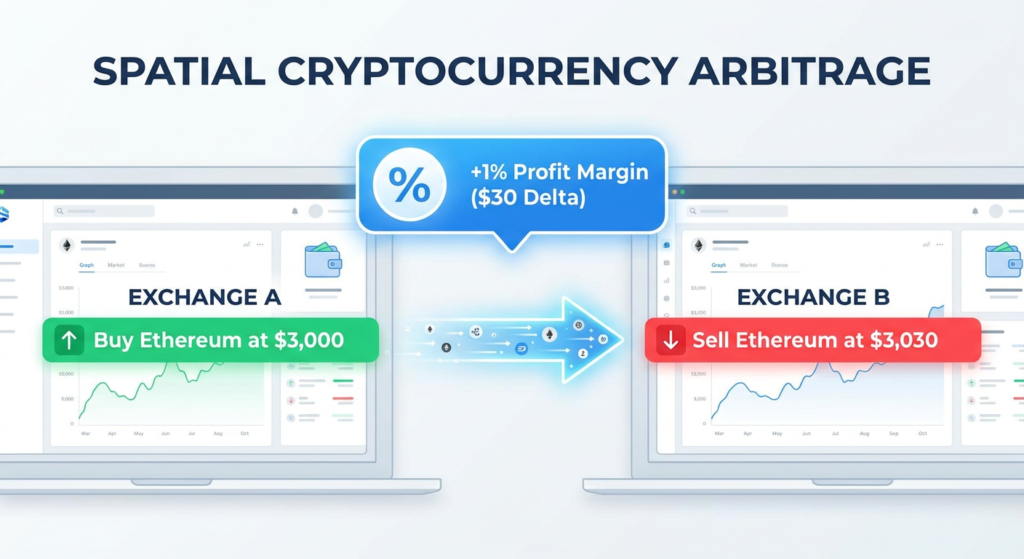
This is the most basic form of arbitrage. It involves identifying a price discrepancy for a single cryptocurrency between two distinct exchanges.
- Scenario: Ethereum (ETH) is trading at $3,000 on Exchange A and $3,030 on Exchange B.
- Execution: The trader buys 10 ETH on Exchange A for $30,000, transfers the ETH to Exchange B, and sells it for $30,300.
- Gross Profit: $300 (before transaction, withdrawal, and network gas fees).
Note: Spatial arbitrage is highly vulnerable to transfer latency. If the price of ETH on Exchange B drops to $2,990 while your transfer is pending, the trade results in a net loss.
Strategy B: Spatial Arbitrage Without Transferring (Simultaneous Execution)
To bypass the risk of transfer delays, professional traders keep pre-funded balances of both fiat/stablecoins and the target cryptocurrency on multiple exchanges.
- Setup: You hold $10,000 USD and 3 ETH on Exchange A, and $10,000 USD and 3 ETH on Exchange B.
- Scenario: ETH is $3,000 on Exchange A and $3,030 on Exchange B.
- Execution: You simultaneously buy 1 ETH on Exchange A (using $3,000 of your USD balance) and sell 1 ETH on Exchange B (receiving $3,030 USD).
- Result: Your total crypto holdings remain exactly the same (6 ETH), but your total USD balance has increased by $30. No assets had to be moved over the blockchain during the trade.
Strategy C: Triangular Arbitrage
Triangular arbitrage occurs within a single exchange, eliminating external transfer fees and blockchain delay risks completely. It exploits discrepancies between three different trading pairs.
       [ USD ]
       /     \
   (Buy BTC)  (Sell ETH)
     /         \
 [ BTC ] ----> [ ETH ]
       (Buy ETH with BTC)
- Step 1: Start with stablecoin capital (e.g., $10,000 USDT). Buy Bitcoin (BTC).
- Step 2: Use that BTC to buy Ethereum (ETH) via the ETH/BTC pair.
- Step 3: Sell the ETH back to USDT via the ETH/USDT pair.
- Result: If the synthetic price of ETH calculated via BTC deviates from the direct ETH/USDT price, you end up with more USDT than you started with.
Strategy D: Decentralized Finance (DeFi) and Flash Loan Arbitrage
With the rise of Automated Market Makers (AMMs) like Uniswap, Curve, and PancakeSwap, arbitrage opportunities between decentralized exchanges (DEXs) are abundant.
Advanced developers utilize Flash Loans—a DeFi primitive that allows users to borrow millions of dollars of crypto assets with zero collateral, provided the borrowed amount plus interest is repaid within the exact same blockchain transaction block.
- Borrow: Flash loan 100,000 USDC from a lending protocol (e.g., Aave).
- Swap 1: Swap 100,000 USDC for Token X on Uniswap (where Token X is undervalued).
- Swap 2: Swap Token X back to USDC on SushiSwap (where Token X is highly valued).
- Repay: Pay back the 100,000 USDC loan plus fee to Aave.
- Profit: Keep the leftover USDC surplus. If the transaction fails to yield a profit sufficient to cover the loan, the entire transaction reverts as if it never happened, protecting the borrower from losing capital (though gas fees are still consumed).
4. Key Risks and Operational Hurdles
While cryptocurrency arbitrage is theoretically low-risk, executing it successfully in the real world presents major operational challenges:
1. Transaction and Exchange Fees
Fees can quickly eat up thin arbitrage margins. You must calculate:
- Maker/Taker Fees: Charged by exchanges for executing orders (ranging from 0.02% to 0.5% per trade).
- Deposit/Withdrawal Fees: Charged when moving fiat or crypto off platform.
- Network (Gas) Fees: Blockchain transaction fees (can be extremely high on Ethereum during network congestion).
2. Execution Latency (Slippage)
Crypto markets move in milliseconds. If you manually attempt an arbitrage trade, the price discrepancy will likely disappear before you can click “Buy”. High-frequency trading bots dominate this space, executing trades in microseconds.
3. Exchange Counterparty Risk
Keeping funds across multiple, lesser-known, or regional exchanges to exploit price differences exposes you to counterparty risks, including exchange hacks, sudden withdrawal freezes, or outright insolvencies.
4. Blockchain Execution Failures
If you attempt a cross-exchange transfer to capitalize on a price gap, network congestion or wallet maintenance on the receiving exchange can lock up your funds for hours or even days, rendering your trade obsolete.
5. How to Get Started: A Practical Blueprint
If you want to start exploring crypto arbitrage, follow these structured steps:
Step 1: Research and Tools Selection
Do not try to find discrepancies manually. Use specialized software and aggregators:
- CoinMarketCap/CoinGecko: Use their “Markets” tabs to visually inspect price differences across major exchanges for specific tokens.
- Coinglass & CryptoWatch: To monitor real-time order book depth and spreads.
- Arbitrage Bots: Look into open-source trading framework software like Hummingbot or paid platforms like Bitsgap and 3Commas to automate your setups.
Step 2: Establish Accounts and KYC
Set up accounts on at least three highly liquid exchanges (e.g., Binance, Kraken, OKX) and complete their Know Your Customer (KYC) verifications. Ensure your deposit and withdrawal limits are fully upgraded to handle rapid capital movements.
Step 3: Capital Allocation
Pre-fund your accounts. For simultaneous spatial arbitrage, keep a balanced split of stablecoins (like USDT or USDC) and major assets (like BTC or ETH) on each exchange.
Step 4: Run Low-Value Test Trades
Before deploying large capital, run micro-trades to test the end-to-end pipe:
- Are your bots executing orders instantly?
- What are the exact fees deducted at each step?
- Does your accounting software correctly track the cost-basis across different platforms?
Step 5: Automate and Scale
Once your calculations are validated and proven profitable, scale up your capital pool and use APIs to automate the monitoring and execution of your trades.
6. Conclusion
Cryptocurrency arbitrage is a sophisticated, market-neutral strategy that rewards speed, access to liquidity, and technical execution. While the days of easy manual 10% spatial arbitrage are largely gone—replaced by highly efficient algorithmic trading bots—profitable pockets still consistently exist in newer DeFi protocols, emerging altcoins, and regional markets.
By understanding the mechanics, strictly managing transaction fees, and keeping security at the forefront of your operations, you can turn market inefficiencies into a predictable, passive revenue stream for your portfolio.