
Bitcoin vs Ethereum: Key Differences Every Investor Should Know in 2026
Bitcoin and Ethereum are the two largest cryptocurrencies by market capitalization, and they’re often mentioned in the same breath — but they were built to solve completely different problems. If you’re deciding where to put your first (or next) crypto dollar, understanding what actually separates them matters more than watching either one’s price chart. Here’s a full comparison of how Bitcoin and Ethereum differ, where each one is strongest, and how to think about holding both.
The Core Purpose: Digital Gold vs. Programmable Platform
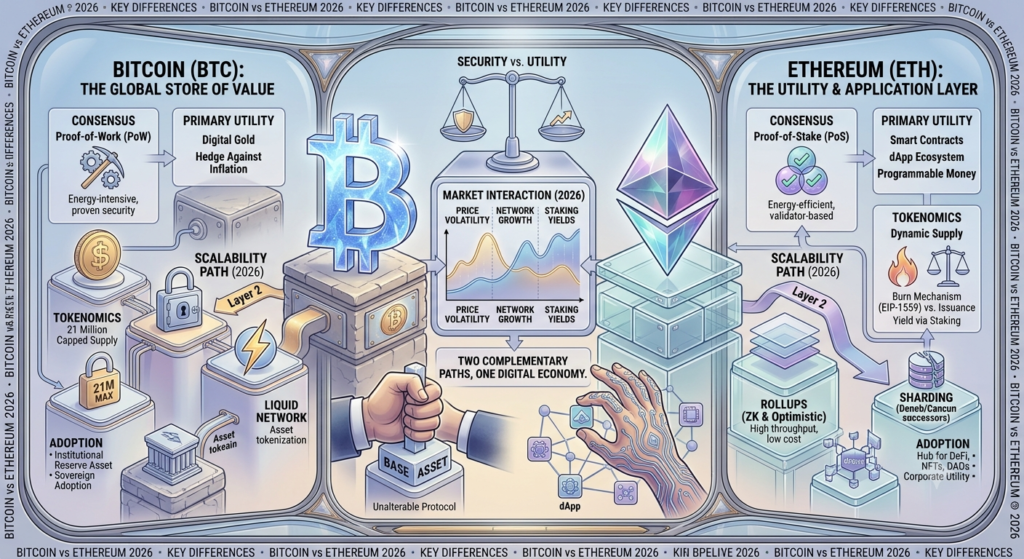
Bitcoin was designed with a single, narrow purpose: to be a decentralized, censorship-resistant form of money that no government or company controls. Its supply is permanently capped at 21 million coins, its code changes slowly and conservatively, and its main value proposition is scarcity and predictability. Many long-term holders treat it as “digital gold” — a store of value meant to sit still rather than be actively used.
Ethereum was built to be a general-purpose computing platform. Instead of just moving value from one wallet to another, Ethereum lets developers deploy smart contracts — self-executing code that can automate anything from a lending protocol to an NFT marketplace to a decentralized exchange. Ethereum doesn’t have a hard supply cap the way Bitcoin does, and its issuance mechanics changed substantially in 2022 when it moved away from mining entirely. The trade-off for that flexibility is a more complex system with a much larger attack surface and a faster pace of upgrades.
Consensus Mechanism: Proof of Work vs. Proof of Stake
This is one of the most fundamental technical differences between the two networks.
Bitcoin still runs on proof-of-work. Miners compete to solve computationally expensive puzzles using specialized hardware, and the winner adds the next block to the chain in exchange for a block reward plus transaction fees. This process consumes significant electricity, which is Bitcoin’s most frequently cited environmental criticism, but it’s also produced over a decade and a half of uninterrupted network security with no successful attack on the base chain.
Ethereum shifted to proof-of-stake in an upgrade known as “the Merge.” Instead of miners, the network is secured by validators who lock up (stake) ETH as collateral and are rewarded for proposing and confirming blocks honestly. Validators who act maliciously can have a portion of their staked ETH destroyed, a penalty called “slashing.” This change cut Ethereum’s energy consumption by more than 99% compared to its old mining-based system and turned staked ETH into a yield-bearing asset, since stakers earn rewards for helping secure the network.
Supply and Monetary Policy
Bitcoin’s monetary policy is famously simple and fixed. New coins enter circulation through mining rewards that halve roughly every four years in an event called “the halving.” Once the 21 million cap is reached — expected sometime around the year 2140 — no new bitcoin will ever be created, and miners will rely entirely on transaction fees.
Ethereum’s supply is more dynamic. There’s no hard cap, but a mechanism introduced in 2021 called EIP-1559 burns a portion of every transaction fee, permanently removing that ETH from circulation. Combined with the sharp reduction in new issuance after the move to proof-of-stake, Ethereum’s supply has at times been mildly deflationary — meaning more ETH gets burned than newly issued — though this fluctuates with network activity and isn’t guaranteed the way Bitcoin’s cap is.
What You Can Actually Do With Each
This is where the practical differences show up most clearly for everyday users.
**Bitcoin’s use cases** are relatively narrow by design: peer-to-peer payments, a store of value, and increasingly, a reserve asset held by corporate treasuries and (in some cases) national governments. The Lightning Network, a second-layer payment protocol built on top of Bitcoin, allows for near-instant, low-fee transactions, extending Bitcoin’s usefulness for everyday payments without changing the conservative base layer.
**Ethereum’s use cases** are far broader. It’s the foundation for most decentralized finance (DeFi) — lending platforms, decentralized exchanges, and yield-generating protocols. It’s the dominant chain for NFTs and remains the most widely used platform for stablecoins like USDC and (historically) much of USDT’s supply, even as other chains have captured a growing share of stablecoin activity. It also underpins a large share of tokenized real-world assets, an area — putting things like bonds and real estate on-chain — that’s grown quickly as regulatory clarity around digital assets has improved in some jurisdictions.
Speed, Fees, and Scalability
Bitcoin processes transactions relatively slowly — roughly one block every ten minutes, with limited transaction throughput on the base layer. This is intentional: it prioritizes decentralization and security over raw speed. For most holders, this isn’t a major issue since Bitcoin is primarily used for storage and occasional transfers rather than frequent transactions, but Layer 2 solutions like the Lightning Network exist specifically to address this limitation for payment use cases.
Ethereum’s base layer also has throughput limits, and fees (“gas”) can spike sharply during periods of high network demand. To address this, the Ethereum ecosystem has leaned heavily into Layer 2 scaling — networks like Arbitrum, Optimism, and Base that process transactions off the main Ethereum chain and then settle the results back onto it. This has dramatically reduced typical transaction costs for everyday DeFi and NFT activity, though it’s added a layer of complexity for users who now have to think about which network their assets are actually on.
## Risk Profile: What Could Go Wrong
Every asset carries risk, and Bitcoin and Ethereum carry different kinds.
Bitcoin’s biggest risks are largely external: regulatory crackdowns in major markets, macroeconomic shifts that reduce appetite for risk assets generally, and the slow-moving but real long-term question of miner incentives once block rewards diminish toward zero. Its code and consensus mechanism are simple and battle-tested, which limits (though doesn’t eliminate) the risk of a catastrophic protocol-level failure.
Ethereum carries those same macro and regulatory risks, plus additional layers of complexity. Smart contracts built on Ethereum have been the target of some of the largest hacks in crypto history — not because Ethereum itself was flawed, but because poorly written application code sitting on top of it created exploitable vulnerabilities. The pace of protocol upgrades, while generally well-executed, also introduces more moving parts than Bitcoin’s comparatively static design.
Which One Should You Own?
This isn’t a question with a universal answer, and it isn’t financial advice — but here’s a useful way to frame the decision:
– If your priority is a simple, scarce, relatively predictable store of value with the longest track record in the space, Bitcoin’s design is built specifically for that.
– If you want exposure to the broader growth of decentralized applications, tokenization, and on-chain finance — and you’re comfortable with more technical complexity and a faster-moving roadmap — Ethereum gives you that exposure.
– Many investors hold both, treating Bitcoin as the “store of value” portion of a crypto allocation and Ethereum as the “growth and utility” portion, similar to how a traditional portfolio might separate blue-chip holdings from growth stocks.
Quick Comparison Table
| Feature | Bitcoin | Ethereum |
| Primary purpose | Store of value / digital money | Programmable smart contract platform |
| Consensus | Proof-of-work | Proof-of-stake |
| Max supply | 21 million (fixed) | No hard cap; partially deflationary via fee burning |
| Typical use case | Payments, holding, treasury reserve | DeFi, NFTs, tokenization, dApps |
| Scaling approach | Lightning Network (Layer 2) | Rollups: Arbitrum, Optimism, Base, etc. |
| Energy use | Higher (mining-based) | Reduced ~99%+ after the Merge |
The Bottom Line
Bitcoin and Ethereum aren’t competitors trying to do the same thing better than each other — they’re built around different philosophies. Bitcoin bets on simplicity, scarcity, and security through minimalism. Ethereum bets on flexibility and utility through programmability. Understanding that distinction is far more useful than trying to pick a “winner,” and it’s the foundation for making any informed decision about how much of each to hold, if any.
*This article is for informational purposes only and does not constitute financial advice. Cryptocurrency markets are volatile, and any investment decision should account for your own risk tolerance and financial situation.*