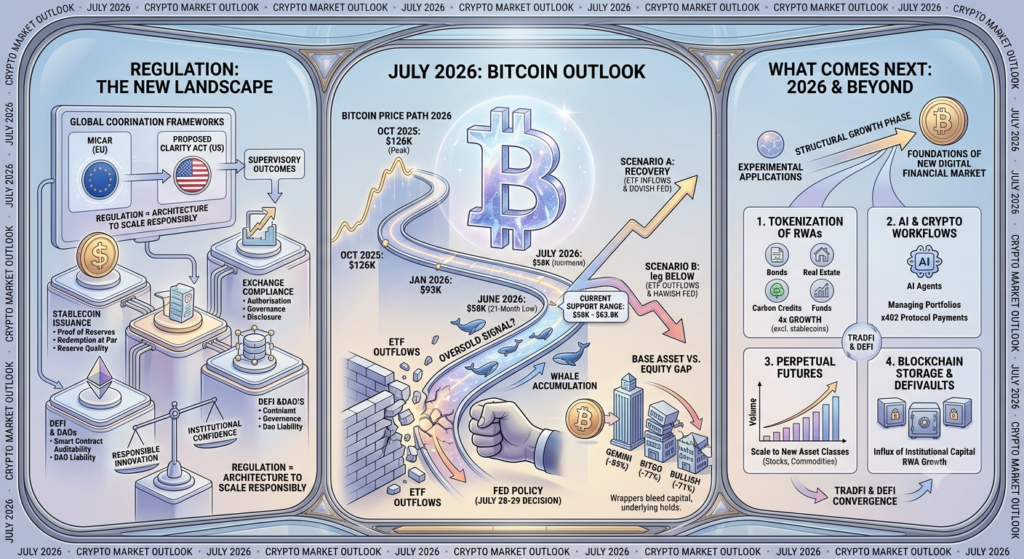

Crypto markets are moving through one of the more uncertain stretches of the year. Bitcoin has clawed back above $63,000 after briefly dipping toward the low $60,000s, Ethereum is hovering near $1,800, and Washington is once again running up against a legislative deadline that could decide how U.S. crypto regulation looks for years to come. If you’ve been away from the charts for even a couple of weeks, a lot has changed. Here’s a full breakdown of where the market stands right now, what’s driving it, and what to watch in the weeks ahead.
Bitcoin and Ethereum: Where Prices Stand Today
Bitcoin has spent the first half of July trading in a choppy range between roughly $62,000 and $65,000, a marked recovery from a brief slip under $60,000 earlier in the year. The rally that pushed BTC toward $65,000 stalled slightly after Strategy (formerly MicroStrategy) sold a portion of its holdings, but corporate treasury buying more broadly has continued to prop up demand even as spot Bitcoin ETFs have seen billions of dollars in net withdrawals in 2026. That’s an important nuance: the ETF structure that was supposed to make Bitcoin’s price action steadier has instead been a source of outflow pressure this year, and treasury companies — firms that hold BTC directly on their balance sheets — have effectively stepped in to fill the gap.
Ethereum has had a rougher time relatively speaking, trading in the $1,700–$1,800 range, well below the $2,000–$2,200 zone many analysts had flagged as a key support band earlier in the cycle. Even so, large holders continue to accumulate. Firms like BitMine have kept adding to their ETH treasuries on a near-weekly basis, with some executives publicly stating a goal of controlling a meaningful share of total ETH supply. That kind of concentrated buying can offset some of the bearish technical picture, but it also means a large amount of ETH’s price stability now depends on the continued conviction of a small number of large institutional buyers.
Beyond the two majors, market breadth has been weak. Solana has fallen into the high $70s to low $80s, and altcoins broadly have underperformed even Bitcoin’s modest recovery. Data through the first half of 2026 shows the combined market capitalization of all crypto assets excluding Bitcoin and Ethereum shrinking by more than 20%, a sign that capital has been rotating into perceived safety — Bitcoin, stablecoins, and a handful of narrative-driven tokens — rather than spreading across the sector the way it did during past bull phases.
Sentiment Is Cautious, Not Panicked
The Crypto Fear & Greed Index has spent recent weeks in “fear” territory, in the mid-to-high 20s on a 100-point scale. That’s not capitulation-level despair, but it’s a clear signal that traders are hedged and reactive rather than aggressively buying dips. A few data points reinforce this cautious mood:
- Coinbase Premium, which compares Bitcoin’s price on U.S. exchanges to offshore venues, has stayed negative for an extended stretch — one of its longest such streaks in years — suggesting relatively soft U.S.-based demand compared to international buying.
- Stablecoin market capitalization has actually declined this year rather than grown, with the combined value of the two largest dollar-pegged tokens shrinking by tens of billions of dollars. Falling stablecoin supply while dominance holds steady suggests investors are pulling capital out of the ecosystem entirely rather than just parking it in cash-like crypto assets waiting to redeploy.
- Liquidations in derivatives markets have been trending down compared to earlier spikes, which is a mildly encouraging sign that leverage has been flushed out of the system and that recent price swings are less likely to cascade into forced selling.
Taken together, the picture is a market that’s stabilizing but still fragile — not obviously heading into a fresh bull run, but not showing the kind of broad capitulation that historically marks a bottom either.
The CLARITY Act: Crypto’s Biggest Regulatory Story of 2026
If there’s one storyline that matters more than any single token’s price chart right now, it’s the fate of the CLARITY Act — formally the Digital Asset Market Clarity Act — in the U.S. Senate.
The bill would establish the first comprehensive federal framework for digital assets, splitting oversight between the SEC and the CFTC. Under the proposed structure, assets that function more like investment contracts would fall under SEC jurisdiction, while assets that behave more like commodities or network tokens would be regulated by the CFTC. It builds on the GENIUS Act, the stablecoin-focused law signed in mid-2025, by extending a similar level of regulatory certainty to the broader digital asset market, including exchanges, brokers, and token issuers.
The bill cleared the Senate Banking Committee in mid-May on a largely party-line vote, with two Democrats crossing over to support it, and was placed on the Senate’s legislative calendar in early June — a procedural step that made it eligible for a full floor vote. From there, momentum stalled. As of early-to-mid July, the bill has not received a cloture motion, and industry estimates on the odds of the bill becoming law before the end of 2026 have slipped from the 70%-plus range down into roughly the 40–60% range depending on the source, largely because the Senate’s return from recess in mid-July leaves only a few realistic legislative weeks before the chamber breaks again for August recess.
Three disputes have kept the bill stuck:
- Ethics and conflict-of-interest provisions. Democrats have pushed for enforceable rules limiting how elected officials and senior government employees can personally profit from crypto ventures while in office — an issue that has taken on extra weight given how deeply involved some political figures have become in stablecoins, meme coins, and mining ventures.
- Developer protections. Provisions modeled on the Blockchain Regulatory Certainty Act would shield software developers who don’t custody user funds from being treated as money transmitters. Law enforcement groups argue this doesn’t go far enough to prevent illicit use of decentralized platforms.
- Stablecoin yield. Banking industry groups worry that language in the bill could let crypto platforms offer interest-like rewards to stablecoin holders, potentially pulling deposits out of the traditional banking system. Crypto companies counter that rewards would only apply when stablecoins are actively spent, not simply held.
Why does this matter for everyday investors and builders? A finalized regulatory framework tends to make institutional capital — banks, asset managers, pension funds — far more comfortable allocating to digital assets, because it removes the ambiguity that has driven a decade of enforcement-first regulation in the U.S. It would also likely accelerate tokenization of real-world assets like bonds, real estate, and equities, an area that’s been held back specifically by the lack of clear rules. If the bill stalls past the August recess, expect continued volatility tied to political headlines, and expect the “regulatory clarity” premium currently priced into some U.S.-listed crypto stocks and tokens to fade.
The Global Picture: Other Jurisdictions Are Moving Faster
While Washington negotiates, other regions have already put comprehensive frameworks into force. The European Union’s Markets in Crypto-Assets regulation (MiCA) reached full enforcement in the first days of July 2026, ending the 18-month transition period during which crypto firms operated under a patchwork of national registrations across the bloc. Of the more than a thousand firms that had been operating under those older national licenses, only a fraction secured full MiCA authorization before the deadline, which is likely to trigger consolidation among smaller exchanges and token issuers that can’t meet the new compliance bar. Ripple, notably, has already secured a full MiCA license, positioning it to operate across all 27 EU member states under one unified rulebook.
Asian financial hubs have also been moving quickly. Hong Kong’s stablecoin licensing regime and Singapore’s expanded digital asset framework have both progressed faster than comparable U.S. efforts this year, and U.S. Treasury officials have publicly acknowledged that regulatory uncertainty at home is pushing some crypto companies and developers to consider relocating to jurisdictions like Singapore and Abu Dhabi. South Korea, meanwhile, has expanded its judicial system’s ability to enforce civil judgments against virtual assets, a step toward treating crypto holdings the same way courts treat traditional bank accounts and property in debt collection and legal disputes.
The takeaway for anyone watching the space: the “will the U.S. regulate crypto” question is increasingly less about whether regulation happens globally — it’s happening — and more about whether the U.S. keeps pace with allies and rivals who’ve already built their rulebooks.
Security Incidents Are Still a Real Risk
Even with more institutional money flowing into the space, security remains a persistent weak spot. In recent weeks, a governance attack against BonkDAO saw an attacker spend several million dollars acquiring tokens specifically to force through a malicious proposal, ultimately draining roughly $20 million from the project’s treasury. Separately, international law enforcement coordinated a takedown of a scheme responsible for over $100 million in crypto-related fraud, a reminder that while institutional adoption gets most of the headlines, retail-facing scams and exploits haven’t gone away.
For everyday holders, the practical lesson is unchanged: self-custody where possible, be skeptical of any protocol asking you to vote on governance proposals you don’t fully understand, and treat unusually high yields or urgent-sounding token unlocks and airdrops as a red flag rather than an opportunity.
What’s Actually Working Right Now
It’s not all downside. A few corners of the market have shown real strength:
- DeFi lending on newer chains. Deposits into lending markets on the Monad network, for instance, crossed $100 million within just days of launch, showing that capital is still willing to chase new yield opportunities when the product and incentives are compelling.
- Everyday crypto payments. Wallet providers have reported crossing meaningful user milestones, with daily active payment users now outnumbering pure traders for the first time on some platforms. Spending activity in emerging markets — Southeast Asia, South Asia, Africa, and Latin America — has grown dramatically faster than in developed markets, suggesting crypto’s most durable use case may end up being everyday payments and remittances rather than speculative trading.
- Tokenized real-world assets. Trading volumes in tokenized equities and similar instruments have surged even as broader altcoin markets have struggled, another sign that institutional-grade use cases are maturing even during a rough patch for speculative tokens.
Practical Takeaways for July 2026
If you’re trying to make sense of where things stand, here’s the condensed version:
- Bitcoin remains the market’s anchor. It’s holding up better than most altcoins, supported by corporate treasury buying even as ETF flows have turned negative for the year.
- Ethereum’s price has lagged, but concentrated institutional accumulation is providing a floor.
- Altcoins broadly are in a deeper drawdown than the headline numbers suggest. Liquidity has narrowed sharply outside of Bitcoin, Ethereum, and stablecoins.
- The CLARITY Act is the single biggest near-term catalyst for U.S. crypto markets. Watch the Senate’s floor schedule through late July; if it slips past the August recess, expect the bill’s odds — and the sentiment boost tied to it — to fade further into the fall.
- Global regulation is arriving with or without the U.S. MiCA is now fully in force in the EU, and other financial centers are moving in the same direction.
- Security and governance risks haven’t disappeared. Treat DAO governance votes, sudden token listings, and unusually attractive yields with caution.
None of this is investment advice — crypto markets remain volatile, regulatory outcomes are genuinely uncertain, and price levels mentioned here will likely be outdated within days. But understanding the underlying forces — treasury company demand, ETF flow dynamics, the CLARITY Act’s path through Congress, and the global regulatory race — gives you a much clearer lens for interpreting whatever the charts do next.
This article reflects market conditions and legislative status as of mid-July 2026. Crypto markets move quickly; always check current prices and the latest regulatory developments before making investment decisions.