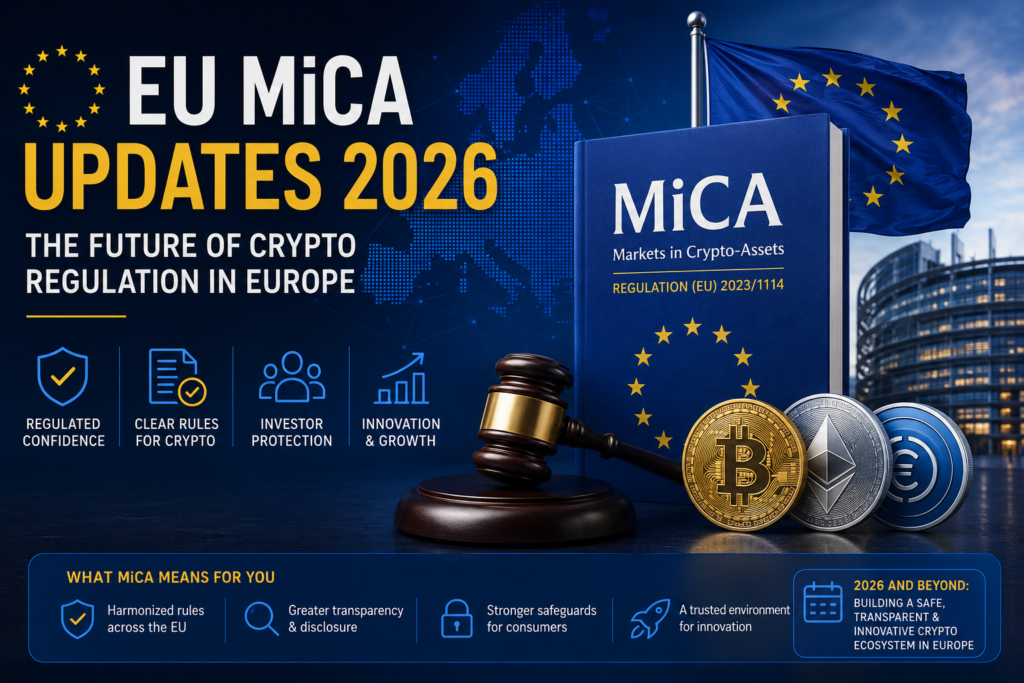

The cryptocurrency industry has long struggled with regulatory uncertainty. While blockchain innovation expanded rapidly across the globe, businesses and investors often faced inconsistent rules from one country to another. Europe has taken a significant step toward solving this challenge through the Markets in Crypto-Assets Regulation, commonly known as MiCA.
MiCA represents one of the most comprehensive cryptocurrency regulatory frameworks ever introduced. By establishing a unified legal structure for digital assets across the European Union, MiCA aims to provide legal certainty, improve consumer protection, and encourage responsible innovation.
As implementation progresses in 2026, crypto companies, investors, and financial institutions are adapting to a new regulatory reality. Many industry experts believe MiCA could become the global benchmark for crypto regulation.
This guide explores the latest MiCA updates, key compliance requirements, impacts on the crypto industry, and what businesses and investors need to know moving forward.
What Is MiCA?
MiCA stands for Markets in Crypto-Assets Regulation.
It is a regulatory framework developed by the European Union to govern digital assets and cryptocurrency-related services across member states.
Before MiCA, each EU country had its own approach to cryptocurrency regulation. This created compliance challenges for businesses operating across borders.
MiCA solves this problem by creating a unified framework that applies throughout the EU.
The regulation covers:
- Crypto-asset service providers (CASPs)
- Stablecoin issuers
- Cryptocurrency exchanges
- Custody providers
- Trading platforms
- Wallet services
- Certain token issuers
The primary goal is to establish consistent rules while supporting innovation and protecting consumers.
Why MiCA Matters
The introduction of MiCA is considered one of the most important regulatory developments in crypto history.
Its significance comes from several factors.
Regulatory Clarity
Many businesses avoided expanding into crypto due to legal uncertainty.
MiCA provides clear guidelines regarding:
- Licensing requirements
- Consumer protections
- Operational standards
- Disclosure obligations
Consumer Protection
The framework introduces safeguards designed to protect retail investors from fraud, misleading information, and operational failures.
Market Stability
By regulating stablecoins and service providers, MiCA seeks to reduce systemic risks within digital asset markets.
Innovation Support
Rather than banning crypto innovation, the regulation aims to create a safe environment where blockchain businesses can grow responsibly.
Key Objectives of MiCA
The regulation focuses on several major objectives.
Creating a Single European Market
MiCA enables crypto companies to operate throughout the EU under a common regulatory framework.
Protecting Investors
Disclosure requirements and operational standards improve transparency and accountability.
Preventing Market Abuse
The regulation introduces rules against insider trading, market manipulation, and unfair trading practices.
Enhancing Financial Stability
Special attention is given to stablecoins because of their growing role in payments and financial infrastructure.
Crypto-Asset Service Providers (CASPs)
One of MiCA’s most significant components is the regulation of Crypto-Asset Service Providers.
CASPs include businesses offering:
- Crypto trading
- Exchange services
- Custody solutions
- Portfolio management
- Crypto transfer services
- Advisory services
To operate legally within the EU, CASPs must obtain authorization and meet regulatory standards.
Requirements for CASPs
Authorized providers generally must demonstrate:
- Adequate capital reserves
- Strong governance structures
- Effective risk management
- Cybersecurity safeguards
- Consumer protection procedures
- Operational resilience
These requirements are intended to strengthen trust within the crypto industry.
The Passporting Advantage
One of MiCA’s most attractive features is the concept of passporting.
Under passporting rules, a crypto company authorized in one EU member state can provide services across the entire European Union without obtaining separate licenses in each country.
Benefits of Passporting
- Reduced regulatory complexity
- Lower compliance costs
- Easier market expansion
- Greater competition
- Improved consumer access
For crypto businesses, passporting may significantly accelerate growth opportunities within Europe.
Stablecoin Regulation Under MiCA
Stablecoins have become a major focus of regulators worldwide.
Because stablecoins can function as payment instruments and stores of value, regulators view them as potentially systemically important.
MiCA introduces detailed requirements for stablecoin issuers.
Asset-Referenced Tokens
These tokens maintain value by referencing one or more assets.
Examples may include:
- Currencies
- Commodities
- Financial instruments
Issuers must meet strict governance and reserve requirements.
E-Money Tokens
These tokens are linked to a single official currency, such as the euro.
Issuers must comply with standards similar to those applicable to electronic money institutions.
Reserve Management Requirements
Stablecoin issuers generally must:
- Maintain sufficient reserves
- Protect reserve assets
- Provide transparency
- Ensure redemption rights
These measures aim to reduce the risk of stablecoin failures.
Consumer Protection Measures
Investor protection is one of MiCA’s central pillars.
The regulation introduces multiple safeguards designed to improve transparency and accountability.
White Paper Requirements
Crypto projects issuing tokens often must publish detailed white papers.
These documents typically explain:
- Project objectives
- Technology
- Risks
- Governance structure
- Token economics
This helps investors make more informed decisions.
Transparency Standards
Businesses must provide accurate and non-misleading information regarding products and services.
Complaint Handling
Consumers benefit from formal complaint procedures and dispute-resolution mechanisms.
Risk Disclosure
Companies must clearly communicate potential investment risks.
Market Abuse Prevention
MiCA introduces rules aimed at preventing unfair market practices.
Insider Trading
Using non-public information for trading advantages is prohibited.
Market Manipulation
Activities designed to artificially influence asset prices are restricted.
Unlawful Information Disclosure
Improper sharing of confidential market information can result in penalties.
These measures bring crypto markets closer to standards applied in traditional financial markets.
Operational Resilience and Cybersecurity
Cybersecurity remains one of the biggest challenges facing digital asset businesses.
MiCA places strong emphasis on operational resilience.
Required Security Measures
Crypto firms are expected to implement:
- Cybersecurity controls
- Risk monitoring systems
- Incident reporting procedures
- Data protection safeguards
- Business continuity plans
Strong security standards help protect both consumers and market integrity.
Impact on Crypto Exchanges
Crypto exchanges are among the businesses most affected by MiCA.
New Compliance Obligations
Exchanges must:
- Obtain authorization
- Implement AML procedures
- Maintain operational controls
- Protect customer assets
- Provide transparent disclosures
Benefits for Exchanges
Although compliance costs may increase, regulated exchanges may benefit from:
- Greater customer trust
- Easier institutional partnerships
- Enhanced credibility
- Access to larger markets
For many firms, regulatory compliance may become a competitive advantage.
Institutional Adoption and MiCA
Institutional investors often require clear legal frameworks before entering emerging markets.
MiCA provides several elements institutions value.
Legal Certainty
Clearly defined rules reduce legal risk.
Standardized Compliance
Uniform standards simplify due diligence processes.
Enhanced Market Confidence
Investor protections may encourage broader participation.
Improved Infrastructure
Regulated service providers can support institutional-grade operations.
As a result, MiCA could accelerate institutional adoption of digital assets across Europe.
Challenges Facing Crypto Companies
While MiCA offers many benefits, compliance is not without challenges.
Increased Costs
Companies may face higher expenses related to:
- Licensing
- Legal services
- Compliance programs
- Reporting systems
Operational Adjustments
Businesses may need to modify existing processes to satisfy regulatory requirements.
Resource Requirements
Smaller startups may struggle with the administrative burden associated with compliance.
Despite these challenges, many industry participants view regulation as a necessary step toward long-term growth.
How MiCA Affects Investors
For investors, MiCA introduces several positive developments.
Greater Transparency
Enhanced disclosures improve investment decision-making.
Better Consumer Protection
Regulated providers are subject to stricter oversight.
Reduced Fraud Risk
Market abuse regulations may improve market integrity.
Increased Confidence
A regulated environment can encourage broader participation.
Investors should still conduct independent research and understand the risks associated with digital assets.
MiCA and Global Crypto Regulation
The impact of MiCA extends beyond Europe.
Many policymakers worldwide are closely monitoring its implementation.
Potential Global Influence
MiCA may influence future regulations in:
- North America
- Asia-Pacific
- Latin America
- Middle East markets
Its success or failure could shape how other jurisdictions approach cryptocurrency regulation.
International Regulatory Competition
Countries seeking to attract blockchain businesses may adopt similar frameworks to remain competitive.
This could lead to greater global regulatory consistency over time.
Future Trends for MiCA in 2026 and Beyond
Several trends are expected to emerge as implementation continues.
Greater Institutional Participation
Regulatory clarity may attract banks, asset managers, and financial institutions.
Expansion of Regulated Stablecoins
Compliant stablecoins could become more widely used across payments and settlements.
Consolidation Within the Industry
Smaller firms may merge or partner with larger organizations to manage compliance costs.
Improved Consumer Trust
As protections strengthen, public confidence in crypto markets may increase.
Innovation Within Regulatory Boundaries
Businesses are likely to develop new products that align with MiCA requirements while continuing to innovate.
Best Practices for Crypto Businesses
Companies operating within Europe should consider:
- Understanding MiCA requirements thoroughly.
- Investing in compliance infrastructure.
- Strengthening cybersecurity programs.
- Maintaining transparent communication with customers.
- Monitoring ongoing regulatory developments.
- Seeking legal guidance when necessary.
Early preparation can help businesses gain a competitive advantage.
Conclusion
The Markets in Crypto-Assets Regulation represents a landmark moment in the evolution of cryptocurrency regulation.
By creating a unified framework across the European Union, MiCA provides clarity, consistency, and consumer protection while supporting innovation within the digital asset industry.
For crypto businesses, compliance may require significant investment and operational adjustments. However, the long-term benefits include greater market access, improved credibility, and stronger investor confidence.
For investors, MiCA introduces a safer and more transparent environment that could encourage broader participation in digital asset markets.
As implementation continues throughout 2026 and beyond, MiCA is likely to influence not only Europe but the future direction of crypto regulation worldwide. Businesses and investors who understand these changes will be better positioned to thrive in the next phase of the global digital asset economy.